Friday, January 15, 2021

Pop Culture Dominates My Communications, Who Knew?!?!

 It had not really occurred to me how much I depend on “Pop Culture” in my everyday way of communicating, until I was trying to describe a man that I had seen in the grocery store to my husband, Mark. I was telling Mark that this man looked like a throw back from a 70’s band. He seemed unimpressed, Mark had a very sheltered teen life and did not understand what could possibly be funny about a clean-cut man in a collared shirt, he was thinking Pat Boone. (That was his point of reference from the 70s.)

This man did not look like that, he had exceptionally long, unusually thick, and curly hair that he wore down his back. He had on a collarless, long sleeved, V-necked sweater, and very tight pants. It was not until I described this stranger as a man that belonged in a “Hair Band” like Hurricane, that my husband understood the reason I thought he looked out of place and comical.


This conversation, along with the reading for this week’s assignment, spurred a real curiosity about how much I reference a rhetorical artifact in conversation in a single day. I was shocked! On Monday, January 11, I referenced either a band, song lyrics, movie, or tv show 79 times, and that is just what I caught. I counted another 62 times by someone who was either talking to me or had sent an email reference the same list of artifacts. (Those were just the references I understood.)

So, the question I am asking myself now is; when I make an ad for someone that wants to brand their product or service, is it better to tie in a significant popular culture artifact, or is it better to try to create an original sign?

Example:

Like a Good Neighbor, State Farm is there. This ad is creating an ideology that neighbors are good, and your insurance should be like that.

Security is a priority, not an option, Smart Choice. This insurance ad is simple rhetoric just to make you think about your insurance as a responsibility.


So, from my point of view, there are many Pop Culture artifacts that can fit any one situation. Choosing the correct one all depends on how you are feeling that day.

What is your feeling about creating an original ad for a new branding, use an artifact that can be easily identified and pull it into the advertising and branding of the product, or create a new and original idea and hope it takes off?

Sign Power


According to Brummett, a “sign is something that induces you to think about something other than itself” (2014, p. 45).  In pop culture, we constantly see signs and our mind immediately jumps to another thought, whether that next thought is intentional or not. Individuals prevalent in media and pop culture are subject to near constant scrutiny and any words, action, or event associated with that person could be inextricably linked to them as a sign or symbol forever. Once we have assigned a meaning to that sign, and that meaning is recognized widely, the sign can become an artifact (Brummett, 2014).

Rudy Gobert of the Utah Jazz was awarded Defensive Player of the Year two consecutive years in 2018 and 2019. Don’t get me wrong; I love Rudy Gobert. But every time I hear his name or see a photo of him, my mind immediately jumps to the video of his outburst during a game when he knocked a cup full of water from the scorer’s table.


Forty-second president of the United States William Jefferson Clinton had a long list of accomplishments while serving in the White House, but whenever I see President Clinton, my mind automatically pops up with his press conference statement: “I did not have sexual relations with that woman…” (Clinton, 1998).


And until Donald Trump was elected president of the United States in 2016, every time I saw him or thought of him, my thoughts went directly to the board room and I could hear him saying “you’re fired”.

Every time I hear a song by “The Chicks”, fka “The Dixie Chicks”, all I can hear is lead singer Natalie Maines telling a British audience in 2003 “just so you know, we’re ashamed the president of the United States is from Texas”.


Unlike iconic and indexical meanings, symbols can change easily, especially as they are influenced by pop culture. Where the Dixie Chicks may have initially enjoyed symbolical meanings of “country” or “America”, after the statement made in response to the Iraq war, the Dixie Chicks’ symbolic meaning transformed into “traitors” and “treasonous”. Donald Trump was successful but was also a direct and unforgiving boss in his television show “The Apprentice” until he was elected to the highest office in the United States and he symbolized the success of an elected official. And President Clinton was admired by many people in the nation until his statements were proven false and he symbolized dishonesty and disrespect. Rudy Gobert symbolized unsportsmanlike behavior with his momentary tantrum after he’d been praised and honored as one of the NBA’s top players. Even though symbols have the potential to change, sometimes they stick and aren’t easily altered. 


Is it fair that we assign symbolic meanings to people who are perpetually in the public eye, oftentimes when they are at their worst? Do the meanings we assign have more to do with us as observers of popular culture than they do with the person/symbol we are assigning the meaning to?


 References:

Brummett, B. (2015). Rhetoric in popular culture. Los Angeles: Sage.


Let's study The Bachelor

I found it interesting to learn more about how many academics balk at the idea of studying pop culture. The reading "Pop Culture Studies Turns 25" illustrated how Ray Browne from Bowling Green State University was a sort of commander of bringing pop culture studies to the academic world. It was not met without hesitation and 'embarrassment' by some academics though. To these criticisms though, Brown said, "I'll file a grievance if you're suggesting there's some aspect of culture that's forbidden to be studied." Professor Christopher Geist of the same university is quoted in the article agreeing with Browne, with a caveat, "I'm not at all afraid to say some TV rots the brain, but I want to understand why people are drawn to it."

While there are many (some would argue all) aspects of pop culture that seem to be pointless, and rot the brain, it's important to look deeper and see why people are drawn to it. I've thought this many times with popular TV shows, what draws people in? As a personal fan of the Bachelor franchise (absolute and total brain rot TV), I would love to uncover the deeper meaning for so many people (including myself) being drawn to what can only be described as a dumpster fire of a TV show. Yet I find myself glued to the TV every Monday at 7 PM. The Bachelor is a part of pop culture, but why? Why has it become so big, and lasted as long as it has? TO study the Bachelor, to some academics, would be an absolute waste of time and resources, but with the following it has, and the power it holds in shaping viewer's ideas of what love and relationships should look like, it's a prime example of something from pop culture that is still worthy of being studied. 


Question for the class: How have you seen your favorite TV shows shape a belief or value of yours?

Exclusion Culture

I remember my very first day of school. My mother was smiling with pride and stood on the back porch to see me off. I turned around to wave to her, then she jokingly called out, “Bye honey, make good choices!” With a laugh at her well-timed movie reference from Disney’s Freaky Friday, I jumped into my car and drove myself off to school.


Yes, I drove myself to my first day of school. It was actually quite safe. 


I was 18 years old and heading to my first day of college, which was technically my first day ever of “real school.” You see, I was raised by parents who decided that homeschooling would be the best education that they could offer their children. On many levels, I agree with my parent’s opinions, but as my life went on I realized that this direction had placed me forever into a unique subculture, and perhaps a unique disadvantage.


Though an excellent choice for traditional academic education, homeschooling severely impacted my informal education of popular culture during my elementary, adolescent, and even high school years.
The author of the article Death by Harry Potter has supplied me with all the knowledge I possess about the story. Though I was the prime age for it while the novels were coming out, I completely missed that train and many others. I can’t sing a single NSYNC, Backstreet Boys, or Britney Spears song. I didn’t even see the movie Mean Girls until I was 29. Finally, it made sense why my best friend called me a ‘loser’ out of nowhere when she picked me up to go shopping years ago. 


From my personal experience, it does not take long to learn that you are not in the know with popular culture. You can quickly sense a feeling of exclusion that can leave you hungry to belong and looking for ways to compensate for your cultural ignorance so you can belong.


The only popular markers that I can utilize to build a sense of belonging are Lord of the Rings, the Office, and Star Wars, which causes me to cling to them more dearly. This sense of belonging at least somewhere helps ease the dread of “not knowing what I don’t know.”


When considering popular culture, individuals can reap social benefits by being familiar with the current artifacts that belong to it, or else experience a negative consequence from their popular cultural illiteracy.
The threat of the unknown negative experience, which can include missing the well-placed reference in a conversation or not understanding a joke, or even God -forbid us looking stupid and harming our public image, helps to foster a fear of what we don't know. We are primed for what is known by the acronym FOMO, fear of missing out. The fear keeps us slaves to the need to consume to belong. 


How does self-monitoring of our own pop-culture literacy impact our ability to function within our culture? 


Pop Culture Norms Becoming a Little Too Normal

I am young. I am only twenty two, so I grew up with social media being my main source of influence of pop culture. Although I have found myself falling in the rabbit whole of comparing myself to others on the internet, there has always been a conscious effort to not let social media norms consume my identity. It is interesting how it has changed throughout the years and how as much as I think I am in the loop and up to date on what the "kids are saying and doing these days" the stubbornness to not let pop culture change my verbiage and actions have kept me out of loop on some trends. 

There are girls on my team that say "yes queen" "you go queen" "my queen" to just about anyone and anything. There are girls that completely identify and justify themselves and actions solely based on what their zodiac sign is and what phase the moon is in. I am not saying that either are poor actions or that they should not be participating in them, my only question is are we becoming what we are seeing on these social media platforms? Are we becoming live action Tiktok's and speaking in the dialogue of comments on our best friends Instagram posts? 

The worst part of how consuming pop culture is, that may differ from others that are older than me, I grew up with social media dominating the pop culture platform. My reality ever since I was in middle school has been a never ended scroll of pretty girls with perfect bodies, hair, skin, and teeth. After typing that sentence I just now realized how powerful pop culture really is. My idea of those perfect standards are because of pop culture. 

The definition of pop culture is everyday objects and actions that influence people to behave in a certain way. That is all done through subtle messages proposing what is desirable, undesirable, good or bad, etc.  It is interesting to see how over time the standard of beauty has changed just as "slang" has. If you are not familiar with TikTok it is a platform that you basically see random videos on a page that is called "For You." There is always videos about how TikTok's algorithm tends to show higher quality videos, in a nice place, and the better your appearance is, the more likely you are to become viral. Are these those "subtle" messages proposing what is desirable? Lets just say every TikTok star I have seen embodies those norms and beauty standards that society has deemed "perfect". 

My question to everyone is did anyone else grow up/ going through the same struggles of the toxicity of social media or have similar experience? Are pop culture norms becoming a little too normal?  (For example in ten years from now your zodiac sign is still an excuse to act in a certain way? Will "yes queen" be a term used only by those in the royal family?)


Streetwear Culture: The Pressures of a Consumer Culture

        Supreme, Off-White, and Yeezy are only a few of the biggest names in streetwear. But what is this phenomenon of over-priced shoes and clothing? Why are consumers paying hundreds of dollars for the latest sneaker trend. Is it fashion or idiocy? 

    There was a viral video from a few years ago that I was reminded of recently (Shown Below). It is of a child who was bullied for wearing a certain brand of shoe, FILA. The child is being recorded and states that he wears these shoes because he likes the color and the style. He then eloquently recalls his conversation with the kids who were picking on him. He repeats it is not a matter what he wears on his feet but what he carries in his mind. He has chosen intelligence over consumerism. He cares not for the external luxuries but favors his own education. This external pressure the child faces is a result of a streetwear culture fueled by a consumer society. The child mentions that he does not wear Jordan brand shoes like many of his peers. Through this act of counterculture, he is then targeted by classmates. 


Streetwear culture is only being fueled by collaborations and resell sites such as StockX and GOAT. Brands such as Supreme and Off-White keep low stock of exclusive items to increase the rarity of such items. Items are purchased and resold at a higher profit margin on the resale apps. These apps guarantee authentication to prevent fakes from being sold. These brands come with a certain level of status. To purchase these brands is to seemingly purchase popularity. To avoid this culture, as portrayed with the child’s choice of FILA, is to portray a level of apathy to the culture. This creates a target. In the case of children, it is bullying. For young adults, it is judgment. 

    So what rules this culture? The simple answer is opinion leaders. Yeezy, one of the original streetwear giants is founded and run by music artist Kanye West. His own popularity drove the beginnings of his now global company. Rapper Travis Scott has collaborated with Nike and Jordan to create signature shoes that sell for $1000+ on resale apps. Opinion leaders guide consumer opinion to the most popular brands and products. As Sewell states, popular culture isn’t culture at all, it’s commerce.

cactus jack x nike wallpaper #2 | Nike wallpaper, Travis scott iphone  wallpaper, Hype wallpaper

Pop - Confession

 I have a confession… I am probably the least engaged person in this class when it comes to pop culture, specifically entertainment. As I was reading module one’s materials and my fellow classmates blog posts I became increasingly, somewhat embarrassingly aware of how little thought I have invested in pop culture, and how my taste in entertainment could reflect my identity. I am very much like Chuck Closterman in his article Death by Harry Potter. Chuck states that Harry Potter is the “one phenomenon that I have missed completely (and mostly I suppose, on purpose.)”

Unlike Closterman, who mindfully chooses what he focuses on, I instead passively allow the tastes and interests of those around me to fill my time and focus. I see now how this can be a dangerous way to live. Sellnow’s writings in The Rhetorical Power of Popular Culture put it well by stating “popular culture is significant because it has the persuasive power to shape beliefs and behaviors.” Although I am not passionate about the many pop culture “artifacts” swirling around me, I am still deeply influenced by them, whether I like it or not. 

As an American child of the 90’s, my exposure to pop-culture was unusually limited. I lived in a rural town with zero businesses or even stoplights. My household was pretty strict. We were not allowed to have video-games  only periodically rented movies, couldn’t’ watch PG13 movies until we turned literally 13, and MTV was deemed “dangerous” after me and my siblings began imitating Beavis and Butthead.


The one exception were books, of which I am still voracious reader. In some ways I am grateful we were so protected, but I have also come to realize that I was also somewhat robbed of the opportunity to form my own tastes, thoughts and opinions during a pretty formative age. Once I was finally on my own, I found myself simply going along with the interest of my peers, coworkers and friends and have continued to do so. 

It has also been especially easy to be a “passive consumer” of pop culture because I married a man who is probably even more into pop culture than our professor! My husband is obsessed with TV, movies, music, commercials you name it. Here is a pretty funny picture of him that accidentally parodied an episode of the the Simpson's (still shot included) we were watching at the moment. 


His favorites are anything 80’s, horror, superheroes, serial killers or spies, and his passion for these things is so huge it has encompassed much of my life as well. Some of his interests I share, and many I do not. After reading Brumett’s writings on the Rhetoric of Popular culture, I have begun to wonder how the cumulative exposure to my husband and other peers pop culture interests have begun to change how I interpret the world around me. I am excited to closer analyze how all this fits together, and also begin mindfully forming my own tastes, interests and thoughts on pop culture as well. 

What pop culture “artifacts” influence your life, are you glad that they do, or wish that they didn’t’?

There's a Wookie, someone named Yoda, and a Princess involved?


Much like Klosterman with Harry Potter, for the longest time Star Wars was information that I did not know. I know, preposterous. It's safe to say that the Star Wars franchise has been embedded in pop culture since it's coming out. 

You can find references to Star Wars in countless tv series and movies. There's always gotta be that one "nerdy" character that knows everything about Star Wars. There's that Halloween episode where someone has to dress up as Princess Leia, Chewbacca, a Jedi or even a stormtrooper. It's hard to not know Star Wars knowledge, even though you don't know Star Wars. I could tell you just about every character name in Star Wars AND know how they looked like from it being in pop culture alone.


It was strange being in college and meeting new people and the amount that asked me about Star Wars. And every time I said, "No, I haven't seen the movies," it was Earth shattering news. Finally, a friend sat me down and showed me every movie in the order they came out. And there I was at 19 yrs old, watching Star Wars for the first time. 

And don't get me wrong, I loved the movies and was happy to see them, but I already knew so much before watching them that it wasn't fun or exciting. 


In the case of me watching Star Wars for the first time, pop culture let me down. I couldn't enjoy the twists and turns of the franchise and wondered if it was my fault for not watching them at a young age.

But how do you get to watch them so young?

The famous "I am your father" scene was more shocking to me in Toy Story than the actual franchise, because I saw Toy Story as a child. My family didn't try to expand my movie knowledge, because they were worried about our financial problems and focused on making sure I didn't forget my Mexican heritage in American society. I probably know more classic Mexican tv shows and movies than I do American ones.

So how does pop culture play with minorities in this country? Am I the only one that feels like I missed out on certain trends or references growing up, because my family didn't want me too Americanized? 

Thursday, January 14, 2021

Tik Tok


Tik Tok:

TikTok has become the most recent example of an ol' fashion pop culture  in today’s society. According to Sellsnow in the chapter “What is popular culture and Why we Study it?” Mediated Popular Culture can be defined as the everyday objects, actions, and events we experience through a media channel that may influence us to believe and behave in certain ways. Thus, making TikTok an experience we all were able to participate in and be influenced by.  As TikTok rose to fame, millions of users worldwide simultaneously was connected by one major media. This New Media became our “normal” after the devastating effects of a worldwide pandemic. TikTok became a hit sensation that made a ripple affect around the world, that managed to record and store everything, everyone was doing during in the midst of the pandemic.


 The article by Klosterman, in Death By Harry Potter comes to mind with how incredibly easy it is to be out of the loop when it comes to this cultural phenomenon that is happening in today’s society. He goes on by saying that if you are not in the know of something, you can be possibly render as irrelevant in a couple of years. Since TikTok’s sudden fame in the past year rose, I have had a good amount of people in my life who still have no idea what TikTok even is. The funny thing is, I see people from ages 9- 80 participating in Tik Tok and it astonishes me that there are people who have no interest in this attraction that everyone is raving about. 

 There were positive and negative repercussions to this ordeal that resulted in multiple headlines and experiences for all users. Algorithm, plays a great role in this with how a simple like, follow, or comment can result in a bombardment of ads and similar content. TikTok is known for the infamous “for you” page that has a completion of everything and anything that is being posted by users on Tik Tok. Usually, many of these videos are on there for the immense amount of likes and interactions it gets from viewers. An example of a positive outcome from Tiktok would be the foodie pages that help avid fans try out new things around their city or town in a click of a button. Hashtags like #foodcheck, #LVfoodie, #UtahCheck, and pages like @HookedLV. Are examples of how we can save the time and money by trusting the taste palate of another individual. Interesting enough, industries use popular culture to persuade and advertise their products in order to make sales.

HookedLV


A negative outcome that came from Tiktok would be the countless unrealistic lives that some creators try to paint in order to get the most views. I find this ironic with how easily influenced we all are with this new profound media. We are not strangers to this type of media, similar forms of media have actually kept us in the loop with what was in style and what is not. From the chapter What is Popular Culture and Why study it , Sellsnow explains that  popular culture is everywhere(p.22). Its outside, its in our community, and now that we have all been confounded to our home it is something, we have a 24/7 access to.


My question to my fellow classmates:

1)         What are some of the positives and negatives you have seen in result with this new found media we call TikTok? And why do you think people are so attracted to it as compared to other forms of social media platforms? 

2)         Do you think those who refuse to download TikTok are missing out on something ? Explain why?


-Allison Arellano

Pop Culture Connects

  Pop Culture Connects


We’ve all had that time when we’ve missed the punch line of a joke that everyone else seems to get. If we want to understand those jokes and memes shared in our closest social circles -- our children and our grandchildren -- we need to make an effort to stay up on it. Relationships are all about relating. If we can’t relate and we can’t connect, we will eventually give up, not caring at all whether or not we do. As Chuck Klosterman said in his Harry Potter article, if we fail to care about knowing what’s going on, we are choosing to construct our own generation gap. He said, “Ignoring a cultural phenomenon today may render you completely irrelevant in a few years.”


My husband and I met and married in the late 1970s. At that time, our access to pop culture in the form of music, movies, fashion, hairstyles, and even celebrities of that time was limited by time and the speed of communication. We depended on the radio, television broadcasts, and network news. We depended on Casey Kasem’s Top 40 and Dick Clark’s American Bandstand to keep us up on what to listen and dance to. We had basically five main television channels to choose from.


The emergence of HBO, Cable TV, and satellite broadcasting changed our home viewing options. Microwaves changed how we ate and “the information highway” known as the internet took us to heights into the future we had never known. The “Generation Gap,” as first coined in the 1960s, was widening like never before. Author and evolutionary biologist, Armand Leroi, speaking of the speed of cultural change, said, “We’re always incredibly impressed by how quickly modern culture changes, especially as we age and lose track of the new music and all the stuff that is happening.” And it surely happens!


As Deanna Sellnow explained, popular culture is everywhere and it is impossible to avoid seeing and hearing it every day. Most homes now have more televisions than they have people. She went on to say that we spend at least 20 percent of our days watching, streaming, or accessing videos via social media networks. 


Without pop culture, we have little to no way to connect with the present -- the here and now -- and our grandchildren. Learning and understanding pop culture connects us as we build relationships through relating. Connecting now will help us connect later. C.S. Lewis said, “There are far, far better things ahead than any we leave behind.” 


                                        Pop culture connects us. 

What pop culture media do you find the most effective in communicating with family and friends?

Wednesday, January 13, 2021

Perception and Culture

Growing up as a southern California kid, living in a diverse community was normal. I knew from a very young age that the children in my classes came from very different backgrounds than me. I also figured out real quick how fortunate I was to have such a steady upbringing in comparison to some of my classmates. According to Brummett's "Rhetoric and Pop Culture," perception is socially grown. Perception is the ability to see, hear, or become aware of something through the senses. 

After I graduated high school, I went on to San Jose University where I completed my freshman year of college. I remember thinking funny is was that I thought I knew about diverse cultures before, when San Jose State opened my eyes to so much more. The people in my classes were from all over the world and Culture Night lined the plaza outside of my dorm with endless amounts of tables displaying who built up SJSU. 


I ended up transferring to SUU the summer going into my sophomore year and boy was that a culture shock. I went from Silicon Valley to little Cedar City, Utah in a short amount of time and I was shook. I had never seen so many white people in my entire life. I also had never really been exposed to the LDS religion and was amazed by how many churches surrounded the community and how beautiful the temple was. I also had never seen or heard of Polygamy and assumed the individuals I saw in Walmart for the first time were Amish. After doing my own research, I had the opportunity to learn and educate myself on these two new concepts. This made me realize how different each spot truly is and that we only know what we are surrounded by. 


For those who didn’t grow up in Utah, did you also mistake a Polygamist for Amish? Are culture misconceptions formed by what is/is not shown in the media?


Wednesday, January 4, 2017

Sample Blog #4

In a single passage, Storey (2009) captures the essence of the Frankfurt School's critique of the culture industry:

"The culture industry, in search for profits and cultural homogeneity, deprives 'authentic' culture of its critical function, its mode of negation - '[its] Great Refusal' (Marcuse, 1968a: 63).  Commodification (sometimes understood by other critics as 'commercialization') devalues 'authentic' culture, making it too accessible by turning it into yet another saleable commodity" (p. 64).

Setting aside the question as to what actually constitutes "authentic" culture -- a question the Frankfurt School never answers satisfactorily other than to say that it pertains to the elite opposite of whatever mass culture happens to deem praiseworthy at the time -- and further setting aside the question of profit -- does the pursuit and acquisition of profit really rob art of its value or authenticity? -- this passage reveals much more than just an indictment against the culture industry's failure to live up to its mission to "stick it to the man." Storey's words (reflective of Adorno and his colleagues) hint at a profound paradox inherent not only in the culture industry, but in much of human history as well.  

I call it the paradox of protest

This paradox bears close resemblance to what Friedrich Hayek observes in The Road to Serfdom (1944).  (Interestingly enough, Hayek, an Austrian philosopher, was a contemporary of the Frankfurt School.)  In his seminal work, Hayek explores the phenomenon that transpires when the state, upon amassing great power, strives to bring about some seemingly well-intentioned end only to eventually come into direct conflict with that end, ultimately causing more harm than had no action been taken at all.  Similarly, the paradox of protest occurs when someone or something, in protest against some perceived injustice or problem, gradually assumes the same qualities as, or becomes far worse than, the very thing against which it rose in protest.  

In the case of the culture industry, this paradox appears to have occurred in that, as Storey writes, the very industry of artists and creators meant to protest capitalism and class structure has come to assume capitalist and class propensities itself, to the detriment of emerging artists and creators who fall outside "the established order." A disgruntled guitarist (Jack Black as Dewey Finn) laments this situation in the musical comedy, School of Rock (2003): 


This phenomenon of "unintended consequences" (to use Hayek's words) permeates both history and mediated pop culture.  Just to list a few examples...  The French Revolution.  The Third Reich.  The Soviet Union.  Idi Amin and Uganda.  Michael Corleone and "The Godfather." Anakin Skywalker and the Sith.  Even the citizens of Gotham in The Dark Knight Rises (2012) fail to recognize the full repercussions of this paradox when incited by a mad man wearing a mask (Tom Hardy as Bane): 


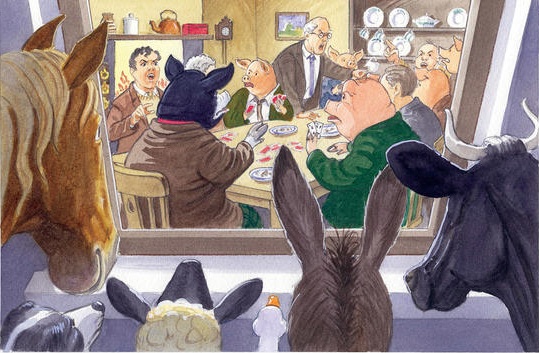
George Orwell, the not-so-subtle critic of totalitarianism (and another Frankfurt School contemporary), probably puts it most solemnly in the final line of his allegorical novel, Animal Farm (1945)

"The creatures outside looked from pig to man, and from man to pig, and from pig to man again; but already it was impossible to say which was which." 


QUESTIONS FOR DISCUSSION: 

1. How does the paradox of protest affect the "authenticity" of mediated pop culture?
2. Is it hypocritical for the culture industry (Hollywood, etc.) to protest ideas it seems to embody or embrace itself?
3. What pop cultural examples of the paradox of protest come to mind for you?